


Every civilization builds tests for truth.
Some ask whether something is correct.
Others ask whether it can be trusted.
Still others ask whether it works.
But civilizations rarely collapse because they lose facts.
They collapse because they lose coherence.
They become precise and fractured at the same time.
We live in an age saturated with verification.
Data is abundant. Accuracy is policed. Correction is instantaneous.
And yet something essential is thinning.
People speak carefully and feel hollow.
Institutions report correctly and betray trust.
Systems deliver answers that are true and outcomes that feel like lies.
Not because the facts are wrong—
but because the way they are carried breaks something human.
This is the paradox of our moment:
We have become exceptionally skilled at determining what is true
while losing our capacity to remain truthful.
The Two Questions We Keep Confusing
Across time and culture, humans have relied on two distinct ways of orienting themselves in the world.
One asks an external question:
Is this true or false?
Does it correspond to reality?
Is it accurate?
Can it be verified?
This question is indispensable.
Without it, there is no shared world.
The other asks a lived question:
Is this spoken in truth, or is it a lie?
Does it align with what the speaker knows and intends?
Does it preserve integrity across time?
Can it be carried without fracture?
This question is also indispensable.
Without it, there is no trust, no moral weight, no durable relationship.
Trouble begins when these questions are collapsed—
or when one is used to erase the other.
Why This Collapse Erodes Agency
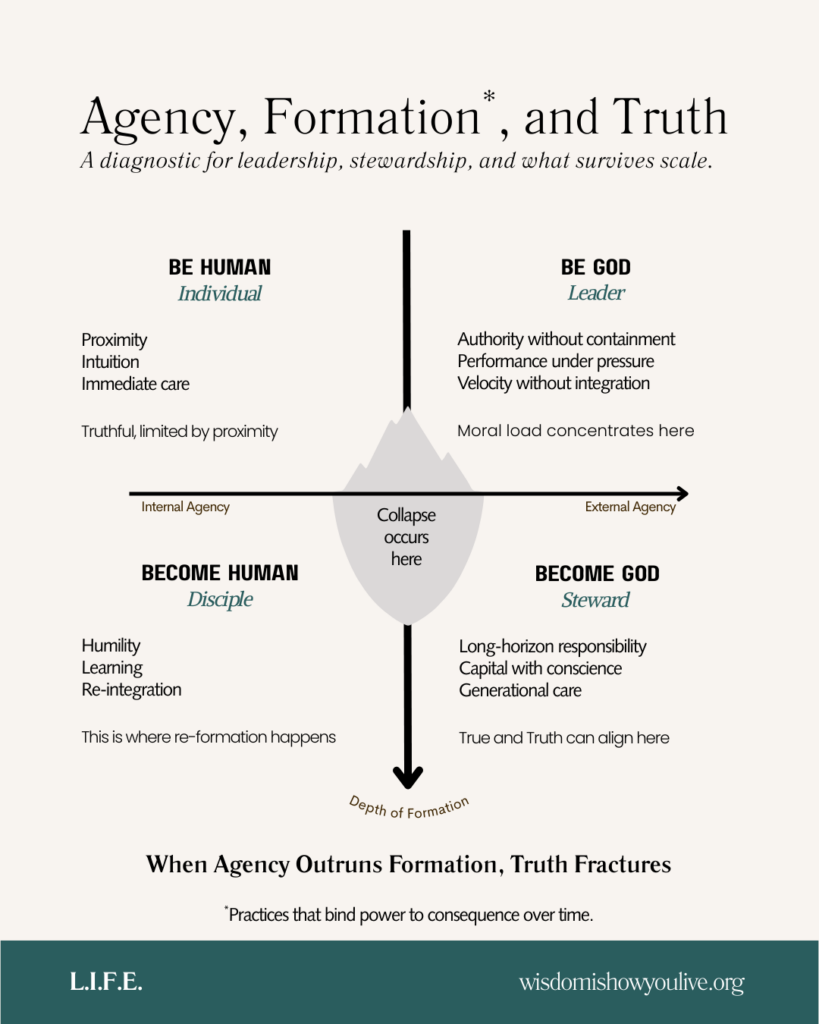
Agency is not authority.
It is not control.
It is not autonomy.
Agency is the ability to move toward the world with integrity—
from the inside out.
And agency does not live purely in the inner world,
or purely in the outer one.
Agency lives in the act of reconciliation:
the capacity to hold internal coherence
while engaging external reality
without surrendering either.
When these axes collapse, agency disappears in predictable ways.
When external correctness becomes the only standard that matters,
humans learn that being accurate is safer than being responsible.
Truth becomes a shield.
Facts become distance.
“I’m just following the data” replaces conscience.
When internal sincerity becomes the only standard that matters,
humans learn that feeling can justify anything.
Reality bends to preserve identity.
Responsibility dissolves into self-protection.
And when the two remain separated but unreconciled,
people simply fracture:
they see what is happening, sense the cost,
and quietly withdraw.
This is how cultures drift.
Not primarily through falsehood,
but through the slow training of humans
to live without the conditions required to choose.
Telling the Difference
Once the distinction becomes visible, four possibilities appear:
| Factual Status | Lived Coherence | What It Is |
|---|---|---|
| True | Truthful | Accurate and whole |
| True | Lying | Correct, but integrity-breaking |
| False | Truthful | Honest error, —in good faith |
| False | Lying | Deliberate deception |
It explains why systems can report correctly
and still betray trust.
It explains why honest mistakes
are often punished as moral failures.
And it reveals something more unsettling:
A statement can be factually true
and still function as a lie
when it is used to evade responsibility,
strip context,
or deny consequence.
Truth without integrity becomes a form of drift.
What Survives
A flood is not only water.
A flood is scale.
Velocity.
Signal.
Extraction.
Noise.
And the defining question is no longer simply:
What is true?
The deeper question is:
What can be carried forward intact
without breaking what makes us human?
Because what survives the flood
is not what is loudest, fastest, or most precise—
but what can hold together
under pressure,
over time,
and across difference.
This is where agency reappears.
Not as control.
Not as certainty.
But as the quiet refusal
to surrender coherence
while reconciling the inner world
with the outer one.
What follows begins here—
with learning how to tell the difference.
This diagnostic emerges from the reflection What I Realized After the Mirror, where integrity is explored as lived coherence rather than correctness.