


Jesus in every breath.
Before theology, there was breath. The Pulse of Union is not a doctrine—it is a rhythm.
It is the living motion of Spirit within creation, remembered through the name of Jesus: Yeshua—the sound of breath itself.
To breathe is to pray. To remember is to return. To live is to join heaven and earth in one quiet pulse.
I. Essence
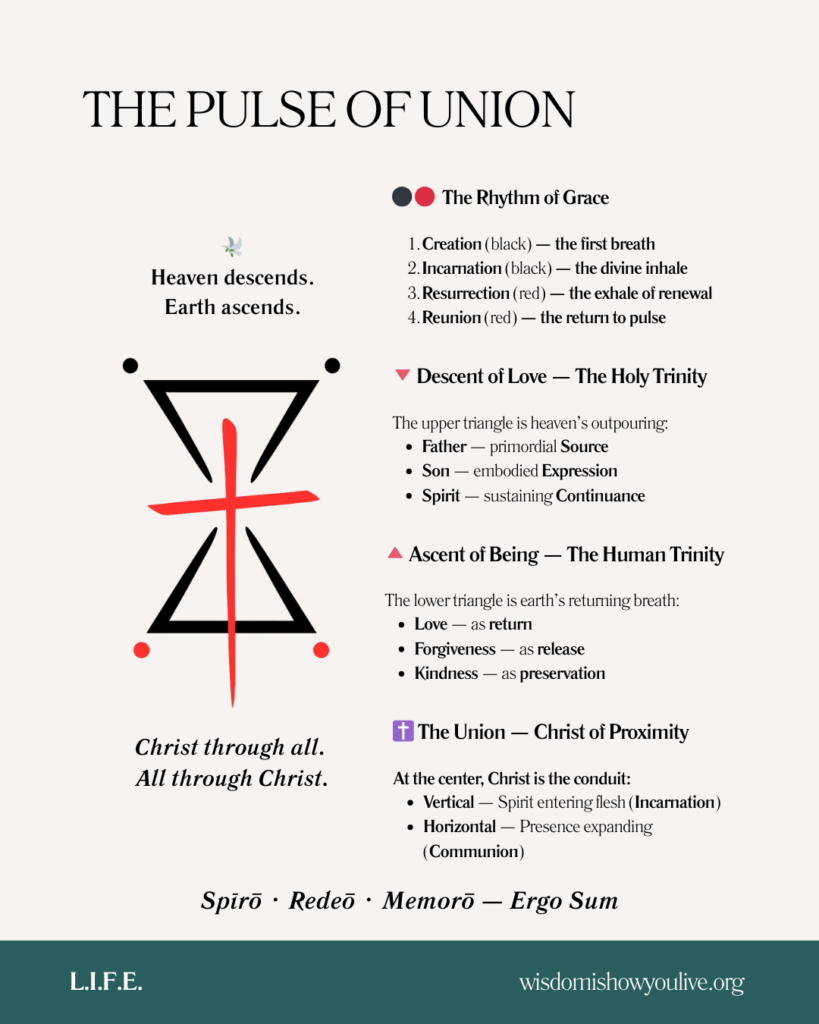
Spīrō · Redeō · Memorō — Ergo Sum
I breathe. I return. I remember. Therefore, I am.
This is the grammar of incarnation. In the silence between inhale and exhale, the divine and the human meet.
The Christ of Proximity—the Christ who draws near—is not distant in heaven or buried in history.
Christ lives in the pulse between your breaths, uniting Spirit and flesh, eternity and now.
Each breath is communion. Each return is grace. Each remembrance is resurrection.
Through breath, we participate in the ongoing creation of all things.
Through return, we enter the cycle of renewal.
Through remembrance, we awaken to what was never lost.
II. Meaning
The Pulse of Union is built on three verbs that describe the motion of life in God.
Spīrō — I breathe.
The Spirit enters. Life begins. Breath is the first sacrament—the invisible made visible.
To breathe is to receive what is not yours, yet sustains you completely.
Redeō — I return.
Every exhale is surrender. Grace completes the circuit of life by giving back what was given.
To return is not to retreat—it is to remember where you came from.
Memorō — I remember.
Awareness bridges what breath began and what grace restored. Memory, in its truest form, is not recollection but reunion.
To remember is to make whole again what separation forgot.
Together, they form the rhythm of Yeshua—the Christ of Proximity—the living reminder that salvation is not a place beyond life, but a presence within it.
III. The Theology of Breath
Across tongues and traditions, breath and spirit share the same word.
In Hebrew—Ruach. In Greek—Pneuma. In Latin—Spiritus. Each means the same: wind, breath, spirit.
To breathe is to speak the name of God. Even without words, the body prays.
Ye — inhale — Spirit enters.
Shu — exhale — Spirit returns.
a — stillness — Spirit rests.
Every breath is creation, crucifixion, and resurrection in miniature. Creation—the inhale of being. Crucifixion—the exhale of surrender. Resurrection—the stillness between them, where love never leaves.
The Pulse of Union remembers what humanity forgot: that the Christ we seek has never been absent—only unremembered.
Jesus is not the exception to being human. He is the full expression of what being human was always meant to be.
IV. The Practice
The Pulse of Union is not meant to be understood. It is meant to be lived. It invites a way of being that breathes Christ into the ordinary.
1. Breathe intentionally.
Each breath can be prayer. Whisper “Ye” as you draw life in, “shu” as you let go, “a” as you rest in stillness.
This is communion without ritual—presence without performance.
2. Return gently.
When you wander, return. When you react, return. When you forget, return.
Every return is redemption, every exhale a confession that grace is already enough.
3. Remember wholly.
Memory restores meaning. To remember is to gather your scattered self and breathe it back into wholeness.
What the world fragments, Spirit reunites.
4. Live proximally.
Christ lives closest where we are most honest—within shared breath, touch, and care.
To live proximally is to live incarnationally: to become what you believe through presence.
V. The Invitation
The Pulse of Union is not something to believe. It’s something to breathe.
You are already breathing Christ. Already participating in the rhythm of redemption.
Already remembered by the breath that created the world.
So breathe again. Return again. Remember again.
For in every breath, Jesus lives—and in every return, you are made whole.