


There is a familiar saying that people remember how someone makes them feel.
What they are remembering is something deeper.
They are remembering presence.
A feeling by itself doesn’t last.
It flares and fades.
What endures is the moment it arrived—
whether someone was actually there when it did.
Presence leaves a trace.
When a moment is fully inhabited, it does not pass through unnoticed.
It settles.
It registers.
It becomes available to return to.
Most moments do not.
They move too quickly.
Attention is divided.
The self is split between being there and getting somewhere else.
But occasionally, something holds.
Those are the moments that remain.
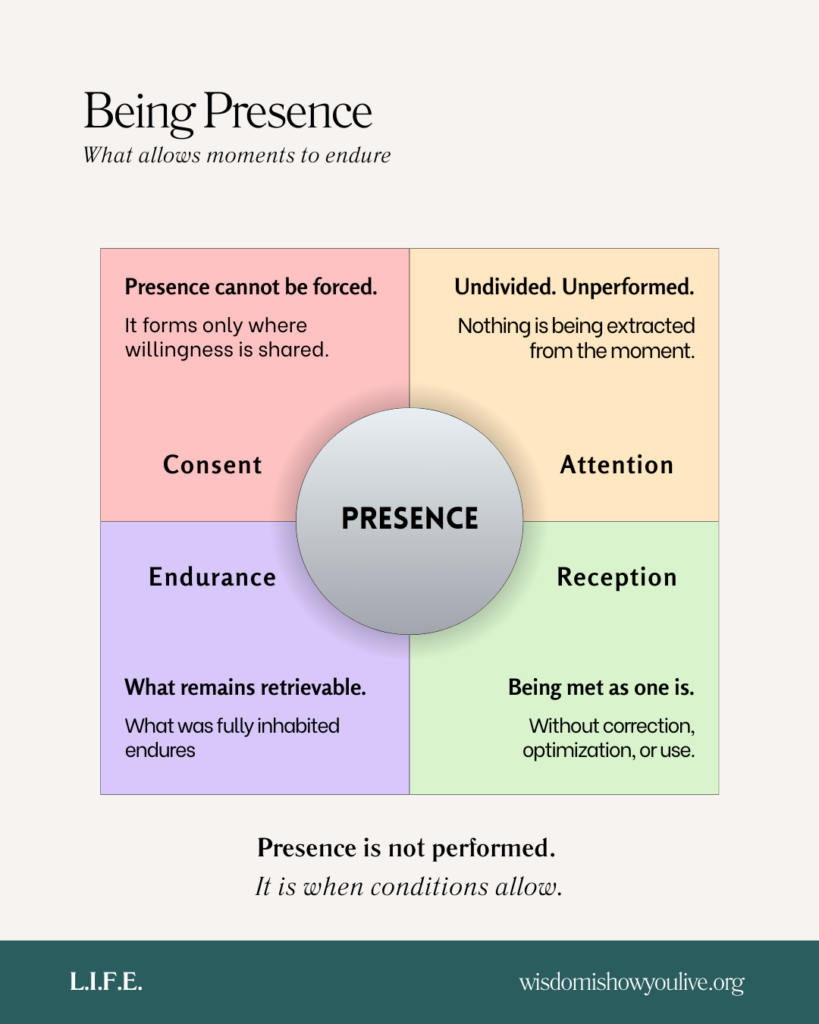
Consent
Presence cannot be forced.
It must be mutual.
It forms only where there is willingness on both sides—
where attention is offered and received freely.
Some moments cannot hold it.
Some conversations pass because one or both are elsewhere.
That is not a failure.
Presence begins where control ends.
When consent is present, the moment stops being managed and begins to be shared.
Nothing needs to be steered or optimized.
The interaction can arrive as it is.
Attention
Undivided.
Unperformed.
Attention has a different texture when it is whole.
It is not angled toward an outcome.
It does not listen while rehearsing what comes next.
Nothing is being extracted.
When attention settles, understanding does not need to be chased.
Orientation arrives on its own.
Meaning lands without force.
Memory forms not from repetition,
but from coherence.
What is attended to fully does not scatter.
It organizes itself around what is real.
Reception
People do not remember being impressed.
They do not remember being persuaded.
They remember being met.
They remember whether they were received as they were—
without correction,
without optimization,
without being turned into something useful.
The feeling remains,
but it is not the source.
It is the residue of being received.
Presence that receives rather than manages changes the nature of the moment.
It stops being transactional
and becomes inhabitable.
Endurance
What is fully inhabited begins to endure.
Later, what returns is not only what was said,
but the posture,
the pause,
the quiet shift when understanding passed between.
The moment remains retrievable
not because it was dramatic,
but because it was held long enough to settle.
Not everything lasts.
Only what was entered.
There are memories like this in every life.
Moments that stay not because they were extraordinary,
but because they were fully inhabited.
What would change
if this became more common?
If presence were practiced not as intensity,
but as availability.
If attention were offered without performance.
If reception replaced management.
If moments were allowed to endure.
It is unclear whether the world, as it is currently arranged, could hold this.
But what is fully inhabited does not end with the moment.
It becomes available to those who come after.
The work continues.
Memory remains.
Just presence.