


There are moments in life when something truer than identity arrives.
Something deeper than preference, personality, or plan.
A quiet inner clarity that precedes every story we later tell about ourselves.
For me, that moment happened when I was twelve.
I didn’t know who I would become.
I didn’t know what career I would choose.
I didn’t have answers to life’s questions or visions of what adulthood would demand.
But I knew this:
My life moved from the inside out.
I had a say.
I had a center.
I had agency.
Not authority.
Not autonomy.
Agency—the ability to choose my way toward the world with integrity.
Because if autonomy is a road and control is a map,
agency is the compass we carry no matter where we stand.
It orients us.
It grounds us.
It reminds us who we are even when the landscape shifts beneath our feet.
Every rupture since has not been the loss of that agency, but an encounter with it—
an interruption, distortion, or reorientation of that early knowing.
And as I’ve come to see, what unfolded in my life is also unfolding across our culture.
We are living in an age where agency itself has quietly eroded—individually, collectively, and systemically.
Because beneath all the noise and all the symptoms we talk about—burnout, overwhelm, identity confusion, digital drift, emotional numbness—sits one single, unspoken truth:
The crisis of our time is the erosion of personal agency.
And everything else is downstream.
I. How Agency Shaped—and Reshaped—My Life
1. When Lauren became pregnant
People assume this moment collapses a life.
For me, it expanded mine.
Suddenly, the ground I stood on carried someone else’s weight.
My choices had consequences beyond me.
Agency became relational—a tether, a responsibility, a widening sphere of care.
2. Marriage and the slow drift
There wasn’t one catastrophic event.
Just the subtle erosion that happens when care becomes accommodation,
and peacekeeping becomes self-loss.
My agency didn’t disappear.
It simply learned to survive underground—choosing safety over presence, stability over truth.
This was the first wobble in the sentence I had held since childhood:
“I knew who I was at twelve.”
3. Divorce
Divorce did not destroy my agency.
It revealed which parts were never mine.
I had lived with borrowed agency—shaped by expectation, shaped by fear, shaped by the hope that harmony could be earned by self-erasure.
Divorce forced a return.
It pulled my agency from the margins back toward center.
Painful.
Necessary.
Clarifying.
4. The glioma
Then came the rupture nothing prepares you for.
A moment where I had
no control,
no certainty,
no negotiating power with life.
And yet, something deeper surfaced.
Agency relocated itself from action to orientation.
Even without control, I discovered I still had agency of spirit—
the ability to choose how I met what I could not change.
This was agency purified:
stripped of ego, stripped of performance, stripped of identity.
It is this form of agency that guides me now.
A Bridge Forward
What I lived in the micro, our world is living in the macro.
The personal erosion of agency is simply a smaller echo of a cultural pattern.
What happened to me individually is now happening to us collectively.
II. The Cultural Mirror: Why Everyone Feels Displaced
We live in a time when people feel strangely absent from the center of their own lives.
Our attention is managed for us.
Our emotions are patterned by algorithms.
Our decisions are nudged into predictability.
Our identities are curated for acceptance.
Our meaning is outsourced to systems that do not know our names.
And the emotional cost is real.
When agency erodes, people stop trusting their own inner voice.
They second-guess intuition, apologize for existing, shrink their desires, and over-explain their worth.
They live in a constant negotiation between who they are and who the world will tolerate.
It creates a quiet, disorienting loneliness—the loneliness of living a life you’re not truly choosing.
This erosion is not a personal failure.
It is a cultural condition.
And nowhere is it more visible than in the people expected to hold it:
leaders.
III. The Leadership Crisis Beneath the Leadership Crisis
For twenty years, I watched leaders quietly break under expectations that were never theirs to hold.
They were responsible for people, but had no say in the systems.
Accountable for outcomes, but denied control over conditions.
Tasked with transformation, but stripped of the ability to choose differently.
Here’s one vignette—one of many:
A director sits in her car every morning, engine running,
rehearsing the “right” words for a team she can’t protect
and outcomes she can’t influence.She leads with heart, but every decision must be validated, escalated, or defended.
Her authority exists on paper.Her agency exists nowhere.
And another, from the opposite end of the hierarchy:
A frontline employee in a care facility stands outside a resident’s door,
knowing exactly what the person needs,
but constrained by staffing ratios, time blocks, and directives
designed by someone who has never been in the room.She knows the right thing.
But she does not have the permission to do it.
Different levels.
Same wound.
People are not failing.
People are being stripped of the conditions required to act with integrity.
The Hidden Economy of Compliance
Sponsors rarely strip agency through force.
They do it through reward.
Leadership today is buoyed by a new prosperity gospel—
the promise of financial independence, equity-based wealth, and lifestyle elevation
offered in exchange for spiritual extraction.
The system doesn’t just pay leaders for results;
it pays them for distance:
- distance from discomfort
- distance from the people they serve
- distance from their own inner voice
- distance from the moral cost of decisions they didn’t choose
- distance from the consequences others will feel
The higher a leader rises, the more insulated they become.
The more insulated they become, the less agency they possess.
Because insulation is the easiest way to control a conscience.
This isn’t greed.
It’s drift disguised as reward.
A leader can be materially prosperous and spiritually diminished simultaneously—
rewarded for the very surrender that is hollowing them out.
This is how agency is quietly traded away.
Not through coercion, but through comfort.
The Algorithmic Drift
Another force accelerates this erosion—
quieter than compensation, but just as powerful.
Algorithms now mediate how we work, decide, relate, learn, rest, distract, and even feel.
Not maliciously, but mechanically.
Not with intent, but with scale.
Systems built for convenience have begun to shape our behavior, our attention, and our emotional patterns—
not by taking our agency away,
but by making it unnecessary.
That is the deeper danger.
When choices are automated,
when preferences are predicted,
when information is personalized,
when emotions are engineered,
humans slowly forget how to choose for themselves.
This is not an anti-technology lament.
It is a recognition that convenience has a spiritual cost.
Because meaningful life—the life of conscience, presence, and relationship—
requires agency.
And the more the world accelerates through automation,
the more essential it becomes to protect the human capacity to choose with integrity.
Sponsors have stripped leaders of agency.
And systems have trained us to live without it.
This is why we turn toward stewardship.
IV. The Way Forward: Stewardship as the Restoration of Agency
If erosion is the crisis, then restoration is the remedy.
And the path of restoration is stewardship.
Not ownership.
Not authority.
Not control.
Stewardship is the commitment to restore agency—
in ourselves, and in the communities we serve.
And stewardship works for one simple reason:
It slows the world down to a speed where agency becomes possible again.
Stewardship takes shape through the 4Ls:
Lens, Language, Leadership, Legacy.
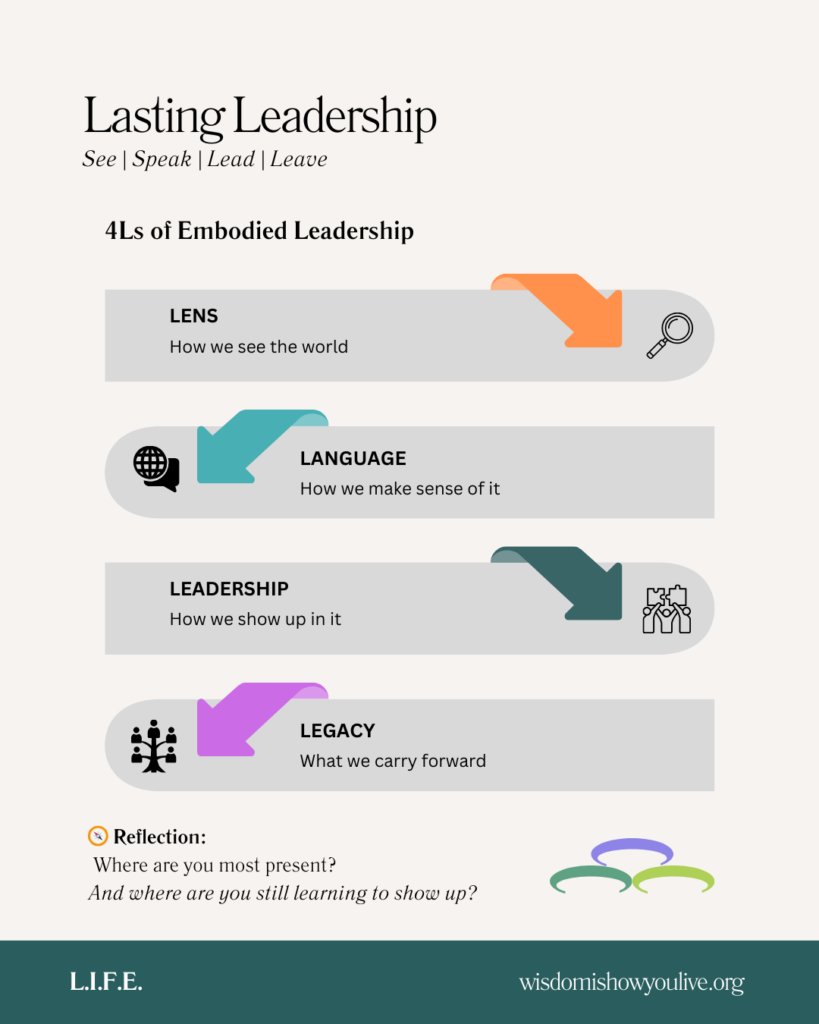
1. LENS — How We See
Stewardship begins with perception.
When vision is distorted, every choice that follows is distorted.
A clear lens restores:
- groundedness
- presence
- truth
- perspective
Agency begins with what we are willing to see—
and what we refuse to ignore.
2. LANGUAGE — How We Name
Language is the architecture of agency.
What we call things shapes:
- dignity
- possibility
- identity
- belonging
Stewardship restores language by returning honesty without harm,
clarity without cruelty,
and truth without violence.
Language gives people back their name—
and with it, their ability to choose.
3. LEADERSHIP — How We Act
Leadership is not the amount of control we possess.
It is the integrity we bring to the choices we do have.
Stewardship re-grounds leadership in:
- courage
- pacing
- presence
- responsibility
- protection
- care
Leaders who restore their own agency
naturally restore agency in others.
This is the leadership that builds trust.
4. LEGACY — How We Leave What We Become
Legacy is not a monument.
Not a static memory.
Legacy is dynamic transmission—
the movement of agency across time.
Legacy is:
- the safety we generate
- the clarity we offer
- the courage we model
- the integrity we embody
- the grace we extend
Legacy is agency made generational.
It is who we become in others.
V. Returning to the Twelve-Year-Old
My whole life, I said:
“I knew who I was at twelve.”
But the truer truth is this:
At twelve, I met my agency.
Every rupture since has taught me what that agency is for.
Not identity.
Not destiny.
Agency.
And this, I believe, is the essential work now—
personally, culturally, and organizationally:
To help each other return to our own agency.
To practice stewardship in every place we touch.
To rebuild the conditions where people can once again move toward the world with integrity.
Because agency is the soil where meaning grows.
And grace is how we rebuild each other.
So begin small.
Restore one tiny piece of agency in yourself or someone you love.
That is how the world begins to return.