


For a long time, we’ve been conditioned to equate awakening with more.
More awareness.
More vigilance.
More knowledge of what’s wrong.
But at a certain scale, more does not awaken—it overwhelms.
The human nervous system cannot stay awake forever.
That’s when I began to see something quieter and more honest:
Woke is not a stance.
It is an adaptation.
Not a climb.
A cycle humans have lived before.
Awakening at Scale
At scale, awakening does not mean seeing everything.
It means learning how awareness changes posture so the human can remain intact.
Across history, this movement repeats:
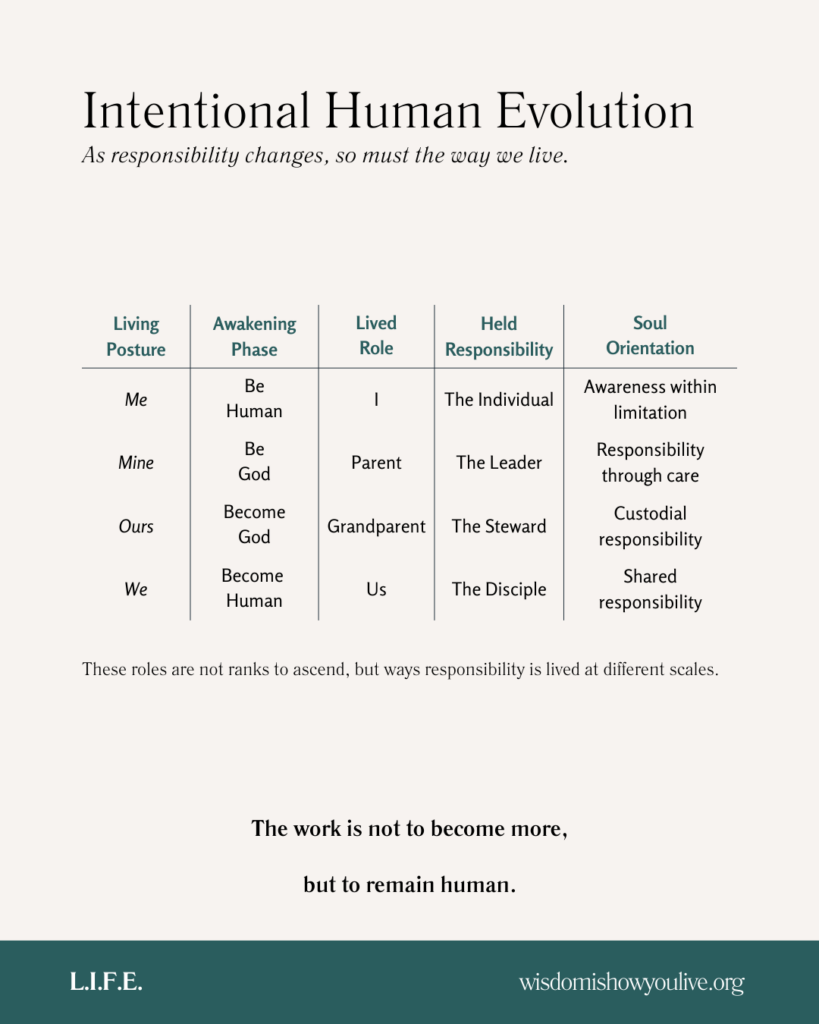
- Be Human — existing inside need, wonder, fear, and limitation
- Be God — taking control to survive scale
- Become God — discovering coherence beyond domination
- Become Human — returning, integrated, unbraced
This is not a moral arc.
It is a survival one.
When the world is small, presence is enough.
When the world grows large, structure appears.
And when structure hardens into domination, something essential is lost.
So awakening adapts.
Responsibility in Motion
Each passage through this cycle reshapes responsibility.
- The Individual — learning to be human within limitation
- The Leader — organizing care as responsibility expands
- The Steward — holding cause without domination
- The Disciple — returning to humanity without retreat
These are not ranks to ascend.
They are roles humans inhabit as awakening widens—and then settles.
Leadership emerges not because we seek power,
but because someone depends on us.
Stewardship appears not because we transcend authority,
but because control no longer creates continuity.
And discipleship is not regression or withdrawal—
it is the return to shared humanity after responsibility has been carried.
Lived Time
This arc does not only shape civilizations.
It lives inside a single human life.
What theology calls Creation–Incarnation–Resurrection–Reunion,
life lives as Me–Mine–Ours–We.
It often begins as Me—
the felt sense of self,
learning how to exist in a body,
discovering where experience begins and ends.
This is lived as I—
a self learning its limits,
its needs,
its voice.
As responsibility expands, the world becomes Mine.
Not possession,
but care.
Something or someone depends on you
more than you depend on them.
This is lived as Parent—
not a role, but a posture,
where protection, provision, and decision
arrive before certainty.
Here, control first feels necessary.
With time, Mine is tested.
What once required command
now asks for continuity.
Responsibility becomes Ours—
shared, inherited, entrusted.
This is lived as Grandparent—
custodial care without control,
holding what must endure
without needing to direct it.
Here, influence replaces force.
And when the grip loosens enough,
Ours gives way to We.
Not the erasure of the self,
but its integration into shared life.
This is lived as Us—
humanity returned without retreat,
presence without possession,
belonging without dominance.
What makes this return possible is not innocence,
but memory.
Only those who remember themselves
from before responsibility outgrew them
can loosen their grip
without collapsing.
A Necessary Clarification
This arc does not belong to everyone in the same way.
Not everyone becomes a parent.
Not everyone leads institutions.
Not everyone holds visible power.
But everyone is asked to reckon with responsibility
as it moves beyond the self.
These are not biological or social milestones.
They are postures responsibility asks of us, however it arrives.
Adaptation, Not Ascent
What fractures us is not awareness itself,
but staying too long in a posture that once served us.
Control, held past its season, becomes domination.
Vigilance, unrelenting, becomes numbness.
Identity, overextended, collapses the self.
Adaptation is knowing when to loosen the grip.
Living the Return
Living intentionally for evolving is not about becoming more enlightened.
It is about becoming appropriate
to the season of responsibility you are in.
Knowing when to hold.
Knowing when to guide.
Knowing when to release.
And trusting that returning to humanity
is not failure—
but wisdom
remembering itself
in the way we live.
In a way, life simply brings us back to ourselves—not as we were, but as we remember.
Acknowledgment
This reflection exists because time once stopped asking me to hurry.
A grade III pontine glioma didn’t give me answers.
It gave me presence.
It interrupted the illusion that I was moving through time
and taught me what it feels like
when time moves through you instead.
Life stopped being something to outrun or accumulate.
It became something to inhabit.
In a quieter way, it shifted my sense of purpose
from progress to coherence,
from becoming more to becoming present,
from mastery to memory.
And yes—if there’s a modern parable for that shift,
it’s the quiet humor of realizing that shrinking
doesn’t make you smaller;
it lets you enter the field
where time behaves differently.
This work is not written about that moment.
It is written from it.