
Kosmos Re-membered
This reflection explores how humans carry what we receive along the trail of time—through systems, communities, protection, openness, and light—and how remembering may ultimately be an act of re-membering.


Creature within creation, held in communion.
That is where I ended The First Order.
I had been trying to trace beneath the many arrangements we inherit—the systems, beliefs, identities, institutions, histories, and categories through which we learn to understand ourselves and one another.
What might have been there before all of them?
Not disorder. Relationship.
Creature within creation,
held in communion.
But that thought left me with another question.
How have we remembered this for so long?
A human life is remarkably brief compared with the story into which it is born.
None of us begins at the beginning.
We arrive somewhere along the way.
We inherit languages we did not invent.
Stories first told by voices we will never hear.
Practices shaped by hands long returned to the earth.
Knowledge gathered through generations of observation, failure, discovery, and wonder.
We inherit ways of naming the world, ways of organizing ourselves within it, and ways of asking what any of it means.
Somehow, what one human encounters can reach another human centuries later.
Through time.
Across communities.
Held by systems.
Perhaps that is one of the most remarkable things humans do.
We remember beyond the limits of our own lives.
A Journey Already Underway
While sitting with that question, an image began forming in my mind.
A lantern hanging from a post beside a trail.
Inside it, a flame. Around the flame, a covering—some parts opaque, some parts clear.
And from the lantern, light reaching into the world around it.
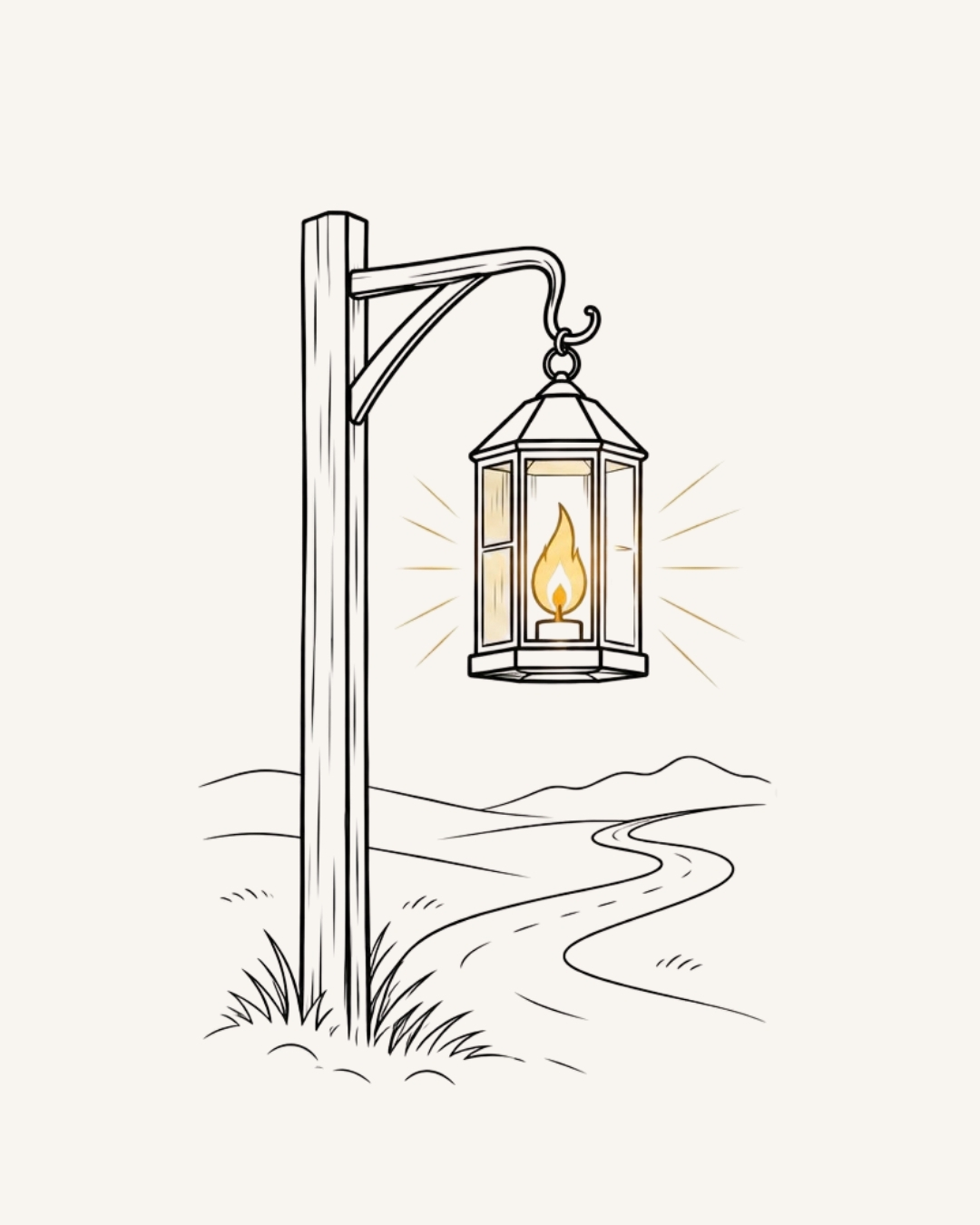
The image began as a way of thinking about the church and what it has attempted to preserve through time. But the longer I stayed with it, the more human it became.
Because perhaps this is not only a story about the church.
Perhaps it is something we have been doing for as long as we have been human.
Flame — What Is Received
Every one of us begins by receiving.
Life itself arrives this way.
And then language. Story. Knowledge. Memory. Wisdom. Meaning.
We do not create these things from nothing.
Much of what eventually becomes ours was already here when we arrived.
A flame is particularly strange in this way.
You cannot really possess a flame.
You can protect it. Feed it. Tend it. Carry it.
You can use it to kindle another flame without diminishing the first.
But the flame only exists while it is living.
Perhaps what matters most across generations is like this.
Not something we possess.
Something we receive and tend.
Trail — Time
And whatever we receive enters time.
I first thought of the winding line in the image as a road.
But a trail feels closer to what time actually leaves behind.
A trail exists because something has passed through.
Those before us leave traces.
Stories. Words. Buildings. Wounds. Songs. Rituals. Discoveries. Customs. Questions. Graves.
Some trails become so well traveled that we barely notice we are following them.
Others become overgrown.
Some divide. Some end.
Some are rediscovered generations later.
And as we travel, we leave traces of our own.
We inherit the trail even as our passage remakes it.
Post — Systems
Along that trail, humans build.
Families. Languages. Schools.
Traditions. Governments. Religions.
Libraries. Laws. Institutions.
Economies.
Systems.
We sometimes speak about systems as though they simply appeared around us. But every system began, somewhere, as human enactment repeated long enough to become pattern, structure, and eventually something another person could inherit.
Like a post planted beside a trail, systems create stability.
They hold things long enough for them to remain when the people who built them are gone.
That makes them extraordinarily powerful.
It also means the post can never become confused with what it was built to hold.
Posts weather. They lean. They rot.
They are repaired, rebuilt, moved, or replaced.
The question is not whether the post remains unchanged.
The question is what it is holding.
Lantern — Community
A post by itself remembers nothing.
People do.
We gather around what we have received.
We tell the stories again. We teach children. We practice rituals.
We debate meanings. We correct one another.
We preserve words. We translate them.
We celebrate. We mourn.
We make things together.
Community gives what has been received somewhere to live.
But communities are living things too.
People arrive and leave.
Languages change. Circumstances change.
Understandings deepen. Conflicts emerge.
New questions appear.
The lantern is therefore not simply a container. It is a gathering around a flame.
A place where what has been received can be tended together.
Opaque — What Protects
A lantern cannot be entirely open.
A flame exposed to every wind will not remain lit for long.
So we protect things.
We create practices, disciplines, boundaries, traditions, rituals, and spaces that shelter what a community has received.
Some things need darkness.
Some things need patience.
Some things need to be held closely before they can be carried farther.
Protection is part of preservation.
But a lantern made entirely of opaque walls would create another problem.
The flame could survive inside it.
No one outside would know it was there.
Clear — What Reveals
So some part of the lantern must be clear.
What has been received must eventually become visible beyond the community that holds it.
Not merely through what the community says, but through what it does.
How people live. How they treat one another.
What they make. What they repair. What they give.
What they refuse to abandon.
Perhaps this is where preservation becomes embodiment.
Something carried from the past becomes present again through a human life.
The flame has not left the lantern.
But now it can be seen.
Light — What Is Given
And then there is light.
Light is not the flame.
It comes from the flame, passes through the lantern, and reaches somewhere the flame itself never goes.
That distinction has stayed with me.
What reaches another person may not be the system that held something, the community that tended it, or even the language through which it was first received.
What reaches them may simply be its light.
Something recognizable. Something illuminating.
Something by which another person can see a little farther along their own trail.
And perhaps that is enough.
Re-membering
When I first began taking this image apart, I thought I was identifying its pieces.
Flame. Trail. Post. Lantern. Opaque. Clear. Light.
But taking it apart eventually revealed something else.
None of the pieces makes much sense alone.
A post with nothing to hold is simply a post.
A lantern without a flame is an empty vessel.
A flame without protection is vulnerable.
Protection without openness becomes enclosure.
Openness without protection cannot sustain what it reveals.
And light without a source cannot illuminate anything.
Their meaning emerges through relationship. Which brought me back to where I began.
Creature within creation, held in communion.
Perhaps communion was never another object to locate inside the image.
Perhaps communion is what makes the image possible.
The post holds the lantern. The lantern holds the flame. The flame gives light. The light reaches creation.
And all of it exists along a trail that began before any one of us arrived and will continue after we are gone.
This made me hear the word remember differently.
To remember is to recall.
But to re-member is also a useful image: to bring members that have become separated back into relationship.
Perhaps that is what each generation is actually asked to do.
Not preserve every post. Not keep every lantern unchanged. Not retrace every footstep.
But receive what has reached us, discern what it is that we are carrying, and re-member the relationships that allow it to live.
Maybe this is one way to think about kosmos—not simply as order imposed upon things, but as things belonging in relationship.
And perhaps the task is not to preserve the kosmos as though it were something finished long ago.
It is to participate in its continual re-membering.
To receive. To tend. To hold. To reveal. To give.
And eventually, to leave something along the trail for those we will never meet.
Creature within creation,
held in communion.
Kosmos re-membered.