
The Calling Is Communion
A reflection on calling, vocation, and communion—and the grace that continues to circulate through others amid uncertainty.


For some time now, I have been discerning what form my vocation might take.
That discernment has unfolded alongside a search for professional work marked by repeated rejections and long stretches of silence. Meanwhile, the pressure of sustaining everyday life has continued to grow.
It is difficult to contemplate calling without also asking practical questions.
How will I provide? What work is available? Where am I needed? What comes next?
I do not yet have clear answers to all of them.
The rejections and silence have been difficult. They have also kept me in a place of discernment, asking not only what work I might do, but how my life and work are called to serve.
And even in this uncertainty, something has become clearer to me.
Grace has continued to find its way into my life through the faces of family, friends, community, colleagues, customers, residents, and strangers.
It has come through generosity, patience, encouragement, conversation, and presence.
The pressure has not disappeared. The uncertainty remains.
But through these encounters, I have been reminded that Life continues to reach me through others.
And I am beginning to recognize that my calling may already be present within that movement.
Calling and vocation
I have come to understand calling and vocation as related, but distinct.
The calling is to be in communion.
Vocation is how that calling takes form in the world: in the work we do, the relationships we tend, the communities we serve, and the responsibilities entrusted to us.
A vocation may take the shape of a profession, a ministry, a season of caregiving, or work we could not have anticipated.
Its expression can change as our circumstances change. But the calling remains.
I am still discerning the form my vocation may take. I do not know precisely where seminary will lead or what work will sustain the life ahead of me. Yet I am beginning to see that I do not have to wait for those answers before participating in the calling.
I can receive care. I can offer presence.
I can listen, work, learn, and live in relationship with those around me.
Even here. Even now.
In Communion
This recognition has emerged through a long journey of writing and reflection, through seminary study, and through the lived experience of this particular season.
What has come into focus, I have called In Communion.
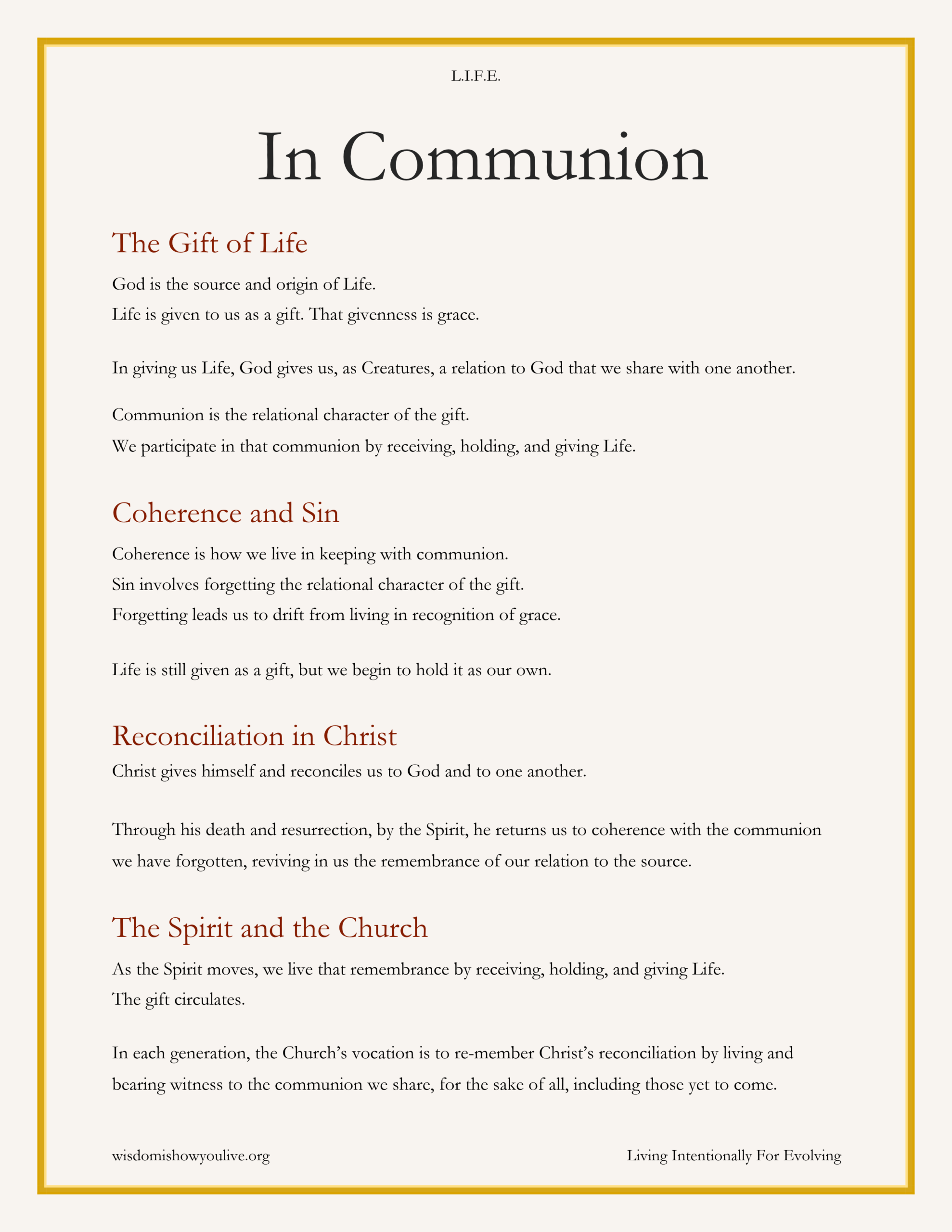
The passages below inform the theological movement expressed above. Some speak directly to the language of gift, reconciliation, or remembrance; others illuminate an aspect of the connections I have drawn among them.
The Gift of Life
- God is the source and origin of Life.
Genesis 2:7; Psalm 36:9; John 1:3–4. - Life is given to us as a gift. That givenness is grace.
1 Corinthians 4:7; Acts 17:25; James 1:17. - In giving us Life, God gives us, as Creatures, a relation to God that we share with one another.
Genesis 1:26–27; Acts 17:26; Malachi 2:10. - Communion is the relational character of the gift.
John 17:21–23; 1 John 1:3. - We participate in that communion by receiving, holding, and giving Life.
Matthew 10:8; Romans 11:36.
Coherence and Sin
- Coherence is how we live in keeping with communion.
Micah 6:8; Colossians 1:16–17. - Sin involves forgetting the relational character of the gift.
Romans 1:21; Deuteronomy 8:11–14. - Forgetting leads us to drift from living in recognition of grace.
Hebrews 2:1; Jeremiah 2:13. - Life is still given as a gift, but we begin to hold it as our own.
Genesis 3:5–6; Luke 12:16–21.
Reconciliation in Christ
- Christ gives himself and reconciles us to God and to one another.
Ephesians 2:14–16; 2 Corinthians 5:18–19. - Through his death and resurrection, by the Spirit, he returns us to coherence with the communion we have forgotten, reviving in us the remembrance of our relation to the source.
Ephesians 1:9–10; Colossians 1:19–20; Luke 22:19.
The Spirit and the Church
- As the Spirit moves, we live that remembrance by receiving, holding, and giving Life.
Galatians 5:25; Romans 8:11. - The gift circulates.
Acts 4:32–34; 2 Corinthians 8:13–15. - In each generation, the Church’s vocation is to re-member Christ’s reconciliation by living and bearing witness to the communion we share, for the sake of all, including those yet to come.
Jeremiah 29:7; 1 Peter 2:9; Psalm 78:4–6.
Life as gift
It begins with a simple claim: God is the source and origin of Life.
We do not give ourselves Life. We receive it. And that givenness is grace.
Scripture speaks of God as the one who gives Life and breath to all. (Genesis 2:7; Acts 17:25)
In giving us Life, God gives us, as Creatures, a relation to God that we share with one another.
We enter a world where our lives are already bound up with other lives and with creation. We receive care before we can understand it, and we continue to depend on gifts that reach us through countless hands.
This is what I mean when I say communion is the relational character of the gift.
We participate in that communion by receiving, holding, and giving Life.
In Life, in a Breath, I reflected on this movement through the rhythm of breathing.
I am now seeing it also as a way to understand calling: to live in recognition of the gift and the relationships in which it is shared.
When vocation forgets
If communion is the relational character of Life, coherence is how we live in keeping with communion. It is how our lives, relationships, and work reflect our recognition of the gift.
The work we do matters. The roles we inhabit matter. The commitments we make matter.
They can become places where Life is received, held, and given.
But a vocation can also forget the calling it serves.
Work can become so absorbed in achievement that it loses sight of the people who make it possible. Ministry can become so concerned with its own continuation that it overlooks the lives it is called to accompany.
A sense of purpose can become so attached to a role that we struggle to recognize our place beyond it.
I know I can lose sight of this too. I can become so focused on finding the right position, doing enough, or securing what comes next that I forget the relationships already holding me.
This forgetting is part of how I have come to understand sin: a forgetting of the relational character of the gift. We drift from living in recognition of grace and lose sight of its source and of one another.
Life is still given as a gift, but we begin to hold it as though it were our own.
Yet the gift remains. God continues to give Life, even when we forget how to live in recognition of it.
Called into remembrance
In Christ, God reconciles us to God and to one another. Scripture also speaks of God’s purpose to gather and reconcile all things in Christ. (2 Corinthians 5:18–19; Ephesians 2:14–16; Colossians 1:19–20)
I understand this reconciliation as drawing us back into the communion we have forgotten. Through the Spirit, we are given Life and called to live in keeping with that gift. (Romans 8:11; Galatians 5:25)
At the table, Christ’s invitation to remember gives this movement a particular shape: remembrance is held in an act of receiving and sharing. (Luke 22:19)
As the Spirit moves, we live that remembrance through receiving, holding, and giving Life.
The gift circulates.
I see the Church’s vocation within this movement.
In each generation, the Church is called to re-member Christ’s reconciliation by living and bearing witness to the communion we share—for the sake of all, including those yet to come.
And just as any vocation can forget its calling, the Church, too, is continually called back to the communion it is entrusted to bear witness to.
The calling remains
I still do not know exactly what form my vocation will take.
But when I look at the people who have accompanied me through this season—and the people I have encountered along the way—I can see that communion has not been waiting for me at the end of discernment.
I have been receiving it. I have been held within it. And, in ways I may not always see, I have been invited to share in it.
Perhaps discernment is not only about discovering the work I am meant to do. Perhaps it is also about learning to recognize the calling within the life I am already living—and allowing that calling to guide whatever vocation takes shape.
The form may change. The path may remain uncertain.
The calling is to be in communion.
And the gift continues to circulate.