
The Years I Tried to Remain Human
Modern systems measure intelligence, productivity, and adaptability. But what measures the degree to which a person remains human through pressure, performance, and change?


I did not spend the last sixteen years trying to understand the human condition.
I spent them trying to remain human within it.
At first, I thought life moved in straight lines.
You grow.
You achieve.
You stabilize.
You build certainty.
You become who you planned to become.
But somewhere along the way, life stopped feeling linear.
The same tensions kept returning.
Different jobs.
Same exhaustion.
Different relationships.
Same longing.
Different fears.
Same instinct to protect myself.
Different versions of success.
Same quiet question underneath all of them:
“Am I disappearing inside this?”
I did not have language for it then.
I only knew that modern life increasingly rewarded fragmentation.
At work, I watched humans become roles.
In systems, I saw performance slowly become survival.
In leadership, I saw how often adaptation slowly becomes identity.
And in myself, I noticed something harder to admit:
the more efficiently I functioned, the easier it became to drift away from parts of myself quietly.
Not dramatically.
Gradually.
The drift rarely looks like collapse at first.
Sometimes it looks like competence.
Professionalism.
Resilience.
Productivity.
Sometimes the cover survives so well that nobody notices the spark struggling underneath it — a distinction I explore in What We Choose to Carry.
Including you.
If I trace the beginning honestly, it probably started in 2009 when I learned Maddie was on the way.
Not because I suddenly became wise.
But because for the first time, another human life made my own humanity unavoidable.
Until then, capability felt sufficient.
Work harder.
Figure it out.
Adapt.
Provide.
But fatherhood introduced a different question entirely:
“What kind of human will my children experience me as?”
Not what I achieved.
Not what I knew.
Not what I could provide.
Who I was while providing it.
That was the first reconciliation.
Me → Mine
Not possession.
Responsibility.
The realization that another life could no longer remain outside my own becoming — the first step in a widening I’ve traced more fully in Dandelion: Weed or Seed?
I did not know it then, but that was the beginning of formation changing shape.
Then came 2014.
Divorce.
And with it came another reconciliation:
Mine → Ours
That threshold altered something deeper than relationship status.
It forced me to confront how often humans confuse love with possession.
How easily identity becomes territorial.
How instinctively we hold people as extensions of ourselves.
But parenthood after separation required something larger.
The children were no longer “mine.”
Not emotionally.
Not spiritually.
They became ours.
Shared responsibility.
Shared formation.
Shared care across fracture.
That season taught me something the world rarely explains well:
Union and separation are not opposites.
Sometimes humans remain bound through what no longer remains structurally whole.
And then came 2017.
Illness.
Not only physical illness, but systems discernment.
The slow realization that fragility was not personal.
It was structural.
Healthcare.
Labor.
Performance.
Economics.
Institutions.
Caregiving.
Exhaustion.
Productivity.
Fear.
I began noticing that the same tensions appearing inside me were appearing everywhere around me too.
That was the third reconciliation:
Ours → We
The widening from personal suffering into shared humanity.
Not ideology.
Recognition.
Most people are trying to survive systems that slowly fragment them while asking them to remain functional inside the fragmentation.
And somewhere across these sixteen years, one question slowly became more important than success itself:
How do I remain human through this?
Not perfect.
Not optimized.
Not transcendent.
Human.
That question changed everything.
Because once I stopped trying to transcend life, I began noticing its recurrence instead.
The same tensions kept returning:
- revealing and protecting,
- moving toward and moving away,
- belonging and separating,
- performing and becoming,
- surviving and remaining alive within survival itself.
Not in circles.
In spirals.
The patterns returned, but never identically.
Grief revisited differently at forty than it did at twenty-five.
Fear changed shape across seasons.
Belonging deepened and fractured repeatedly.
Even healing moved recursively.
I began realizing:
Humans do not move through life in straight lines.
We move through recurring tensions.
And perhaps wisdom is not escaping those tensions.
Perhaps wisdom is learning how to remain coherent while moving within them.
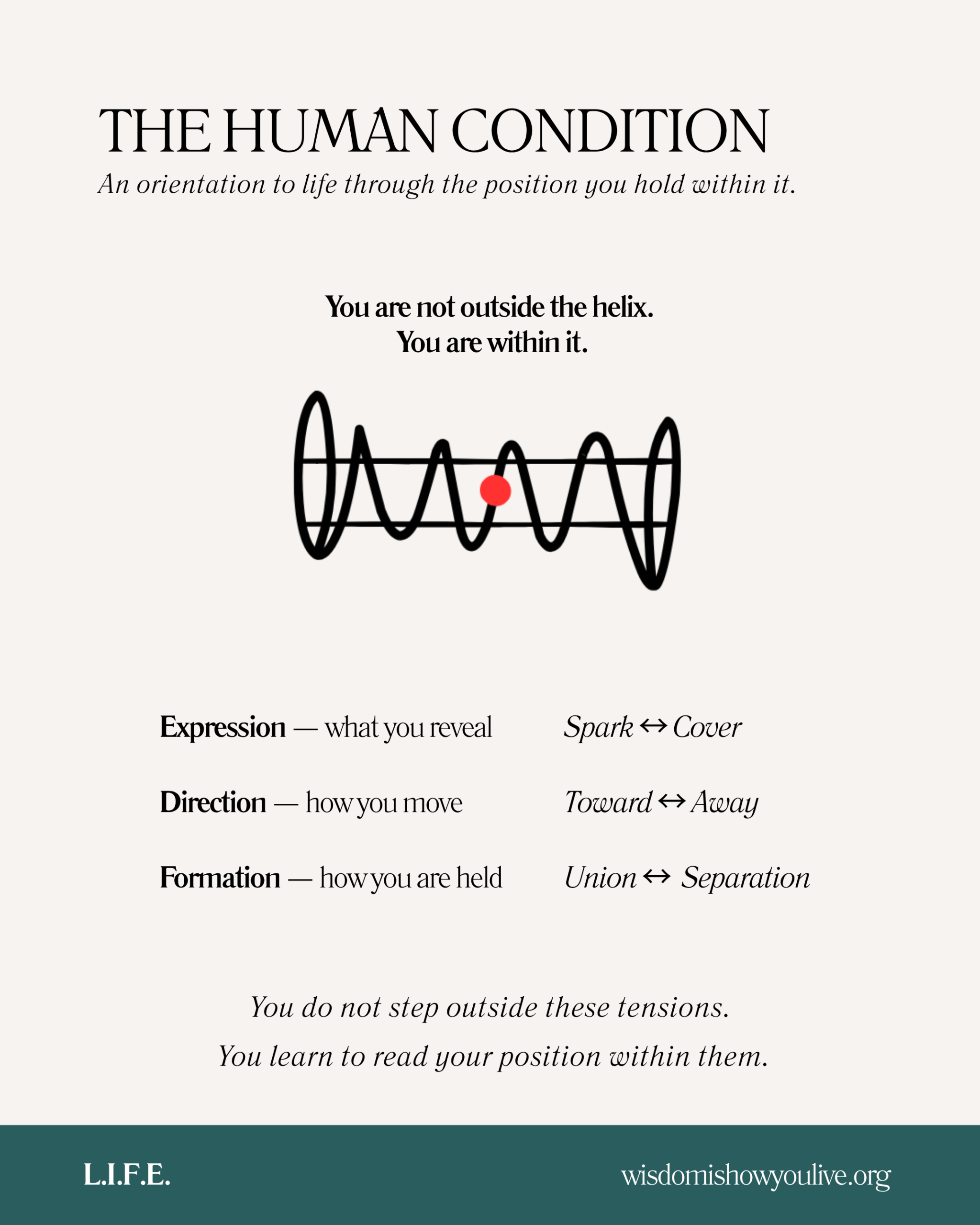
That realization eventually became the Hubert Helix.
Not because I sat down to invent a framework.
But because after enough years of trying not to disappear inside systems, performance, fear, illness, responsibility, and survival, the pattern slowly revealed itself.
The helix was already there.
I was finally close enough to my own humanity to recognize it.
And maybe that is what Human Quotient truly measures.
Not intelligence.
Not productivity.
Not optimization.
But:
the degree to which a person remains recognizably human while life continues reshaping them.
Because the longer I live, the less I believe the future belongs to the most optimized people.
I think it may belong to those who can still:
- feel,
- belong,
- remain present,
- sustain integrity,
- love without performance,
- and stay alive beneath the cover long enough for the spark to keep returning.
Not once.
Again and again.