
The Second Coming: Return, or Revival?
Before humanity ever spoke of a “Second Coming,” it wrestled with a far older question.
How do we live humanly at scale?


Across Sumer, Egypt, the Indus Valley, early China, and the civilizations of the Americas,
humanity encountered the same truth again and again:
intimacy survives in closeness,
but power demands scale.
Long before empires, people learned how to be good close up.
Care was personal.
Responsibility was relational.
Meaning lived in faces, names, stories, and touch.
Love had edges.
Forgiveness had limits.
Kindness moved in circles small enough to be held.
For a time, this was enough.
But as populations grew, intimacy thinned. Responsibility fractured.
Goodness remained individual while systems grew impersonal.
Care could still be practiced—but it could no longer be relied upon to hold the whole together.
Humanity discovered a hard truth:
Individual virtue does not automatically scale.
Care dissolves faster than coordination.
Different civilizations reached for different answers.
- In India, social order preserved duty through kinship, caste, and ritual—strong at proximity, fragile across distance.
- In China, moral hierarchy and virtue sought to humanize power, yet hardened into role and ritual at scale.
- In Russia, communal ideals repeatedly gave way to central authority when trust could not hold.
Humanity learned how to care.
It had not yet learned how to remain human while powerful.
So the world reached a hinge point.
Rome Solves Scale — and Redefines Virtue
The Roman Empire succeeded where others faltered.
Rome did not try to make people loving.
It made systems reliable.
Law replaced memory.
Citizenship replaced kinship.
Order replaced intimacy.
I explored that logic and what it costs in Rome Without Caesar.
Rome did not abandon virtue.
It redefined it.
Virtue was no longer primarily about care between people, but about discipline within the self.
Self-control, obedience, and restraint were cultivated so the system could hold.
Relational virtue was too fragile to trust at scale.
Rome did not depend on virtue holding society together.
It trained individuals in self-control—
so control could become the virtue of the system.
This was not cruelty.
It was effectiveness.
Scale was finally solved.
Humanity was not.
And it is here—inside a world that had mastered control—that something unprecedented appears.
Jesus Reveals the Human Who Can Live at Scale
Jesus of Nazareth does not arrive before scale.
He arrives after it has been solved.
He does not oppose Rome by overthrowing its systems.
He opposes it by refusing to become inhuman within them — which is the posture I explore in Staying Human at Scale: what it costs to remain present when every system asks for withdrawal.
He holds authority without domination.
Truth without coercion.
Discipline without control of others.
He loves without boundary.
Forgives without limit.
Offers kindness without demanding return.
Not as sentiment.
As strength.
He practices self-control—but never to secure power.
Only to remain free for love.
This kind of humanity is destabilizing.
Because systems built on control cannot contain a life oriented toward care.
So humanity rejects completion.
The cross is not only a personal tragedy or a theological necessity.
It is a historical unveiling.
This is what happens when completed humanity meets unfinished systems.
And yet—this is not the end.
The resurrection does not abandon humanity.
It vindicates it.
It declares that this way of being human is not naïve, fragile, or temporary.
It is strong enough to survive empire, violence, and death itself.
From that moment on, the next two thousand years unfold under tension.
The World Keeps Scaling — Without Completing the Human
Rome fell.
Its logic did not.
Systems kept growing.
States. Markets. Institutions. Technologies.
And once again, virtue was cultivated narrowly.
Self-management.
Productivity.
Compliance.
Resilience.
People were trained to regulate themselves so systems would not have to care.
Metrics replaced judgment.
Policy replaced presence.
Efficiency replaced tenderness.
Once again, self-control was trained so control could remain the system’s virtue.
Humanity became astonishingly capable—
and increasingly hollow.
We can coordinate billions and still lose the individual.
Optimize outcomes and exhaust the people inside them.
Build systems that function perfectly while eroding the human soul.
And yet—this matters—
the world did not go dark.
What Was Never Lost
When systems grew cold, someone stayed warm.
When abstraction replaced presence, someone remained.
When care could not be enforced, it was chosen anyway.
Love crossed boundaries without permission.
Forgiveness persisted without accounting.
Kindness was offered with no guarantee it would matter.
Children were held.
Songs were sung.
Stories were told.
Meaning was carried where it could not be organized.
Humanity endured in kitchens, fields, margins, and moments history did not know how to record.
The world did not lose its light.
It learned to hide it in places power could not measure.
And that brings us to now.
The Reviver: A Second Coming Reimagined
At this point in the story, the question of the Second Coming changes.
It is no longer only:
When will Christ return?
It becomes:
Can we finally receive the humanity Christ already revealed—at scale?
That question is what I’ve tried to map in The Coherence Engine — the architecture beneath how systems either sustain or erode life.
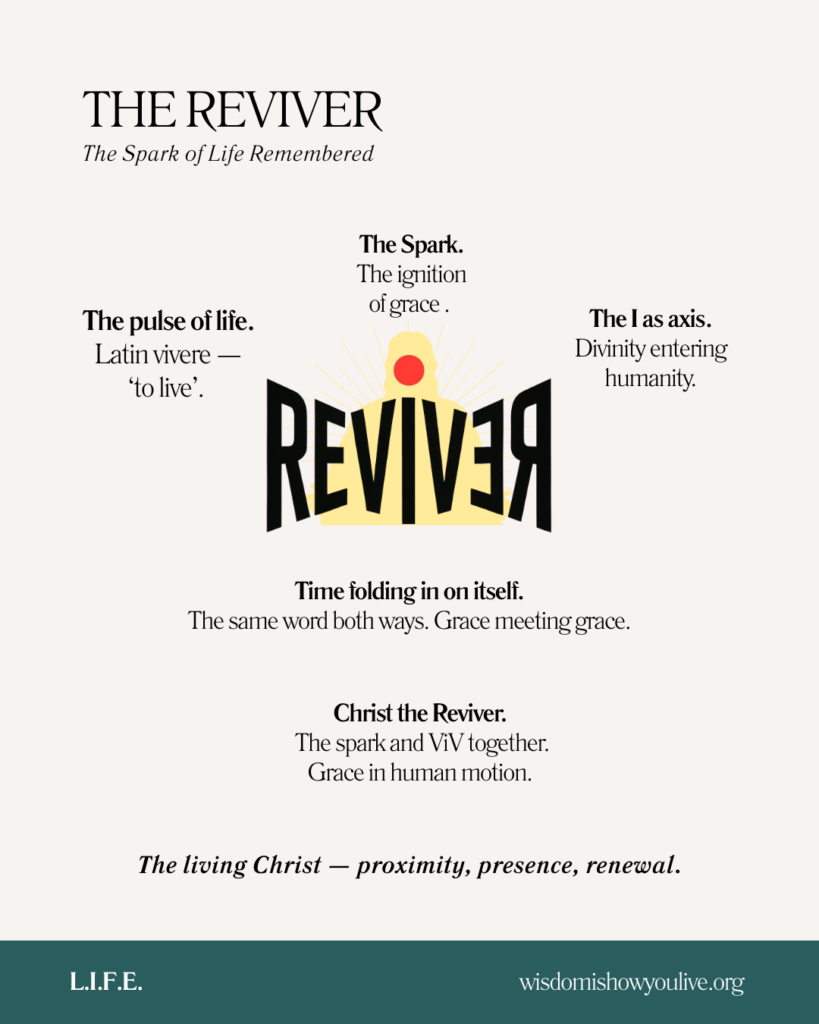
Not an ending. A return.
Not God coming closer—but humanity becoming capable of standing where it can finally see.
This is The Reviver.
Not a conqueror.
Not an enforcer.
Not a system.
Grace moves—through the one who can hold it:
- receiving without shame
- taking without greed
- giving without fear
But a posture the world has encountered before—and resisted.
Love without boundaries.
Forgiveness without limits.
Kindness without expectations.
Not as ideals to admire.
As a way of being strong without becoming hard.
This is the only posture capable of meeting a world shaped by control without becoming it.
The only authority that heals power rather than replacing it.
The only return that does not repeat the first rejection.
And this is the moment humanity must choose.
Either:
- to complete the arc—returning power to presence, systems to service, strength to love
- or to collapse under its own accumulated power
This does not replace the promise of Christ’s return.
It takes it seriously.
Because perhaps the long delay is not absence.
Perhaps it is mercy.
Time given to a powerful but unfinished humanity
to become capable of receiving the perfect human—
not as threat, but as fulfillment.
If the Second Coming is a return, may we be found awake.
If it is also a revival, may we practice now—in how we build,
in how we lead,
in how we forgive,
in how we choose kindness when nothing demands it.Together.
At scale.